

/ Forschung
A new framework for mental health, wellbeing and healthspan optimisation
A new framework for mental health, wellbeing and healthspan optimisation
A recent article published in Frontiers in Psychology proposes the “Watershed Framework of Mental Health and Wellbeing”, a conceptual model integrating biological, psychological and social determinants of resilient living and healthy ageing.
Dr Justin Carrard, Privatdozent and associated researcher in the team of Prof. Arno Schmidt-Trucksäss at the Department of Sport, Exercise and Health, University of Basel, contributed to this interdisciplinary publication together with collaborators from several fields.
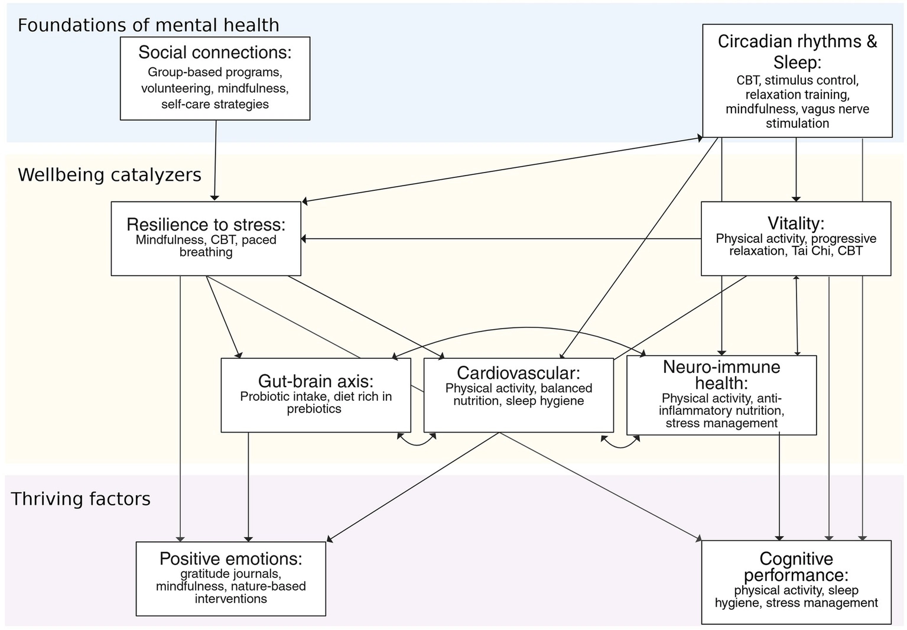
The article identifies nine interconnected hallmarks of mental health and wellbeing: social connections, circadian rhythms and sleep recovery, resilience to stress, vitality, cardiovascular health, neuro-immune health, the gut-brain axis, positive emotionality and cognitive performance. These hallmarks are organised into three interdependent levels: foundational elements, wellbeing catalysts and thriving factors.
The framework aims to support a more integrated understanding of mental health and wellbeing. Rather than focusing on isolated factors, it highlights how lifestyle, physiology, emotional processes, social relationships and cognitive function interact over time. This perspective may help guide future research and the development of comprehensive lifestyle-based interventions for mental health, wellbeing and healthspan optimisation.
For the DSBG, the publication resonates with a broad understanding of movement, lifestyle and physiological health as interconnected dimensions of human wellbeing.
Lifestyle interventions targeting each of the elements of the watershed model of wellbeing and mental health.
Ein neues Rahmenmodell für psychische Gesundheit, Wohlbefinden und gesundes Altern
Ein kürzlich in Frontiers in Psychology erschienener Artikel stellt das sogenannte “Watershed Framework of Mental Health and Wellbeing” vor. Dabei handelt es sich um ein konzeptionelles Modell, das biologische, psychologische und soziale Determinanten von Resilienz, Wohlbefinden und gesundem Altern integriert.
Dr. Justin Carrard, Privatdozent und assoziierter Forscher im Team von Prof. Arno Schmidt-Trucksäss am Departement für Sport, Bewegung und Gesundheit der Universität Basel, war an dieser interdisziplinären Publikation gemeinsam mit Forschenden aus verschiedenen Fachbereichen beteiligt.
Der Artikel beschreibt neun miteinander verbundene Merkmale psychischer Gesundheit und des Wohlbefindens: soziale Beziehungen, zirkadiane Rhythmen und Schlafregeneration, Stressresilienz, Vitalität, kardiovaskuläre Gesundheit, neuroimmunologische Gesundheit, die Darm-Hirn-Achse, positive Emotionalität und kognitive Leistungsfähigkeit. Diese Merkmale werden in drei voneinander abhängige Ebenen gegliedert: grundlegende Faktoren, Katalysatoren des Wohlbefindens und Faktoren des Aufblühens.
Das Rahmenmodell soll zu einem umfassenderen Verständnis von psychischer Gesundheit und Wohlbefinden beitragen. Anstatt einzelne Faktoren isoliert zu betrachten, betont es, wie Lebensstil, Physiologie, emotionale Prozesse, soziale Beziehungen und kognitive Funktionen im Verlauf der Zeit zusammenwirken. Diese Perspektive kann zukünftige Forschung sowie die Entwicklung umfassender lebensstilbasierter Interventionen für psychische Gesundheit, Wohlbefinden und gesundes Altern unterstützen.
Für das DSBG knüpft die Publikation an ein breites Verständnis von Bewegung, Lebensstil und physiologischer Gesundheit als miteinander verbundene Dimensionen menschlichen Wohlbefindens an.
Quick Links
Social Media